Disclosure: This article contains affiliate links. If you purchase a product through one of these links, we may earn a commission at no additional cost to you.

Retinol vs. Retinoid vs. Bakuchiol: What’s the Difference?

The Short Answer
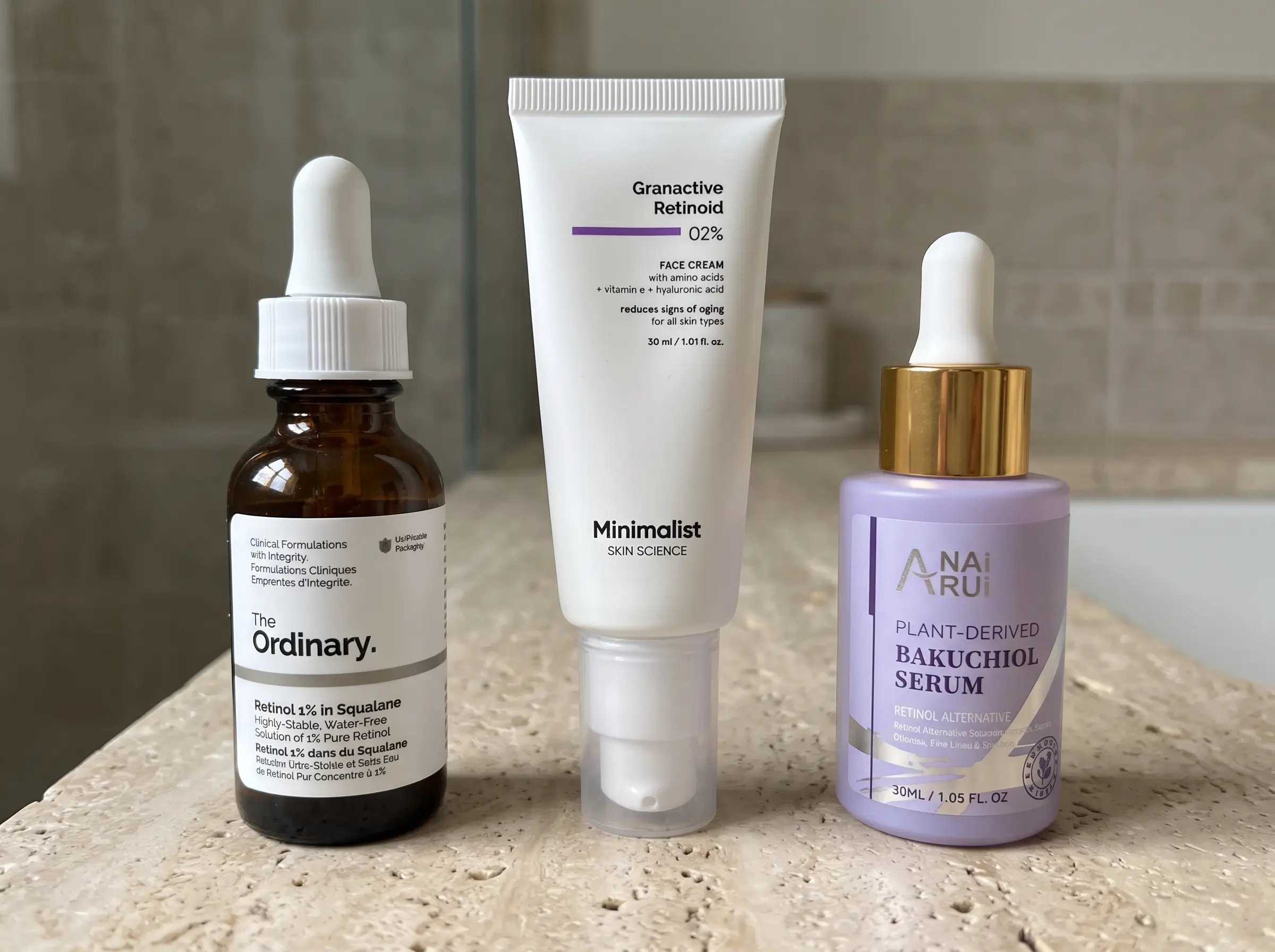
Retinoid is the name for the whole family of vitamin A ingredients. Retinol is one member of that family, and it’s the one you’ll usually find in over-the-counter creams. Bakuchiol is not a retinoid at all. It’s a plant-derived ingredient that’s marketed as a gentler alternative, but it’s much less studied.
In practice, the choice comes down to how strong a product you want, how well your skin tolerates it, and whether you can use retinoids at all.
Why These Terms Get Confused
Skincare labels use these words loosely, and brands sometimes say “retinol” when they mean “a retinoid-type ingredient.” It helps to picture a family tree:
- Retinoids (the family)
- Prescription retinoids: tretinoin (retinoic acid) and tazarotene
- Adapalene: a retinoid available over the counter at a low strength and by prescription at higher strengths
- Over-the-counter cosmetic forms: retinaldehyde (retinal), retinol, and retinyl esters such as retinyl palmitate
So when someone says “retinoids,” they could mean any of these, and when they say “retinol,” they mean one specific, milder type.
How Retinoids Work (In Plain Language)
Retinoids affect how skin cells behave. They encourage faster skin cell turnover and support collagen production, which is why they’re used for fine lines, uneven texture, uneven tone, and acne. Of all the anti-aging ingredients, they have some of the strongest evidence behind them, particularly the prescription ones.
The catch is that skin has to convert most cosmetic retinoids into retinoic acid, the active form, before they work. That conversion happens in steps:
Retinyl ester → retinol → retinaldehyde → retinoic acid
The fewer steps between the ingredient and retinoic acid, the stronger the effect tends to be, and the more likely irritation becomes. That’s why prescription tretinoin (which is retinoic acid) is the most potent and why retinyl esters are the gentlest.
The Comparison Table
| Ingredient | Type | Strength | Irritation Risk | Availability |
|---|---|---|---|---|
| Tretinoin | Prescription retinoid | Highest | Higher | Prescription |
| Adapalene | Retinoid | High (for acne) | Moderate | Over the counter at low strength, and prescription |
| Retinaldehyde | Cosmetic retinoid | Medium to high | Moderate | Over the counter |
| Retinol | Cosmetic retinoid | Medium | Moderate | Over the counter |
| Retinyl esters | Cosmetic retinoid | Mild | Lower | Over the counter |
| Bakuchiol | Plant-derived, not a retinoid | Unclear, likely milder | Lower | Over the counter |
These are general tendencies. Concentration, formula, and your own skin all change the result, and a well-formulated retinol can outperform a poorly formulated stronger ingredient.
Retinol: The Everyday Option
Retinol is the most common choice because it’s strong enough to make a difference but gentle enough to sell without a prescription. Typical over-the-counter strengths run from about 0.1% to 1%.
Who it suits: People who want to improve fine lines, texture, and tone, and who can tolerate some adjustment.
What to expect: A few weeks of mild dryness, flaking, or sensitivity is common at first. Visible improvement generally takes months of consistent use, not days.
Common side effects: Dryness, redness, peeling, stinging, and increased sun sensitivity.
If you’re new to it, our guide to retinol creams for beginners walks through gentle starting options.
Adapalene: The Retinoid You Can Buy Without a Prescription
Adapalene is a retinoid that works directly on skin’s retinoid receptors, without needing to be converted first. At 0.1%, it’s available over the counter and is approved for acne. Many people use it for breakouts, and some use it for general texture and tone as well.
Who it suits: People with acne-prone skin, or anyone who wants a retinoid with a long track record.
What to expect: Like other retinoids, it can cause dryness and irritation at first, and acne can look worse before it improves for some people.
A word of caution: It’s a drug-strength ingredient, so follow the label, and ask a doctor if you have severe or cystic acne.
Prescription Retinoids
Tretinoin and tazarotene are available only by prescription, and a dermatologist can tell you whether they’re appropriate. They’re the most studied retinoids for aging skin and acne, but they also tend to cause more irritation, and they need medical guidance. If over-the-counter options haven’t been enough, this is a reasonable conversation to have with a doctor.
Bakuchiol: The Plant-Based Alternative
Bakuchiol comes from the seeds of the babchi plant. In lab studies, it appears to influence some of the same skin pathways as retinol, which is why it’s often called a “retinol alternative.” But it’s not chemically related to vitamin A.
What the research shows: A small 2019 study compared bakuchiol with retinol over 12 weeks and found similar improvements in wrinkles and pigmentation, with less stinging and scaling in the bakuchiol group. That’s encouraging, but it was a small study, and there’s far less research on bakuchiol than on retinoids.
Who it suits:
- People who find retinol too irritating
- People who prefer a plant-derived ingredient
- People who want a gentler starting point
Limits to know about:
- The evidence is limited compared with retinoids.
- It isn’t proven to match prescription retinoids, especially for acne.
- Allergic reactions are possible, as with any ingredient.
- Pregnancy and breastfeeding safety isn’t well established, so ask your doctor.
Marketing caution: “Retinol alternative” is a marketing phrase. If a bakuchiol product claims it works exactly like retinol, treat that with some skepticism.
Who Should Be Careful or Avoid Retinoids
Talk to a doctor first if any of these apply:
- You’re pregnant, trying to conceive, or breastfeeding. Retinoids are generally avoided in these situations, and a doctor can advise.
- You have eczema, rosacea, or very sensitive skin. Retinoids can aggravate these.
- You’re using prescription acne treatments or other strong topical products.
- You have very dry, cracked, or broken skin.
Everyone using retinoids should use sunscreen daily, since they can make skin more sun-sensitive. If white cast has stopped you from wearing sunscreen consistently, see our guide to sunscreens that don’t leave a white cast.
How to Start Any Retinoid Safely
- Patch test first. Try a small area for a few days.
- Start low and slow. Use a pea-sized amount, once or twice a week at night.
- Apply to dry skin. Damp skin can increase irritation.
- Buffer if needed. Apply moisturizer first, or mix a little into your moisturizer, if your skin is reactive.
- Increase gradually. Add a night every week or two as your skin allows.
- Skip strong exfoliants at first. Don’t combine with strong acids until your skin has adapted.
- Wear sunscreen every morning.
- Keep avoiding the eye area unless the product is made for it. Our guide to eye creams covers options made for it.
- Be patient. Give it at least 8 to 12 weeks before judging results.
- Stop and see a doctor if irritation is severe or doesn’t settle.
For where retinoids fit among your other steps, see our skincare layering guide.
What Pairs Well, and What Doesn’t
| Pairs Well | Use Carefully |
|---|---|
| Gentle moisturizer and ceramides | Strong exfoliating acids at the same time |
| Hyaluronic acid | Benzoyl peroxide on the same night (unless advised) |
| Sunscreen in the morning | Harsh scrubs |
| Vitamin C in the morning, retinoid at night | Several new actives introduced together |
If dark spots are a concern, see our guides to dark spot correctors and vitamin C serums. If you’re building a routine for mature skin, our guide to night creams for mature skin covers richer options.
Which One Should You Choose?
- You’re new to all of this and have normal to dry skin: Start with a low-strength retinol, or bakuchiol if you want the gentlest approach.
- You have acne-prone skin: Consider adapalene, and ask a dermatologist if your acne is moderate or severe.
- You tried retinol and it irritated you: Try a lower strength, less often, or bakuchiol.
- You want the most evidence-backed option for aging skin: Ask a dermatologist about prescription tretinoin.
- You’re pregnant or breastfeeding: Ask your doctor, and avoid retinoids unless they say it’s okay.
If You Only Buy One: Three Examples
These aren’t the only options, and product formulas change, so check each listing for the current version.
- Adapalene: Differin Gel is the best-known over-the-counter adapalene. It’s aimed at acne and is a retinoid, so follow the label.
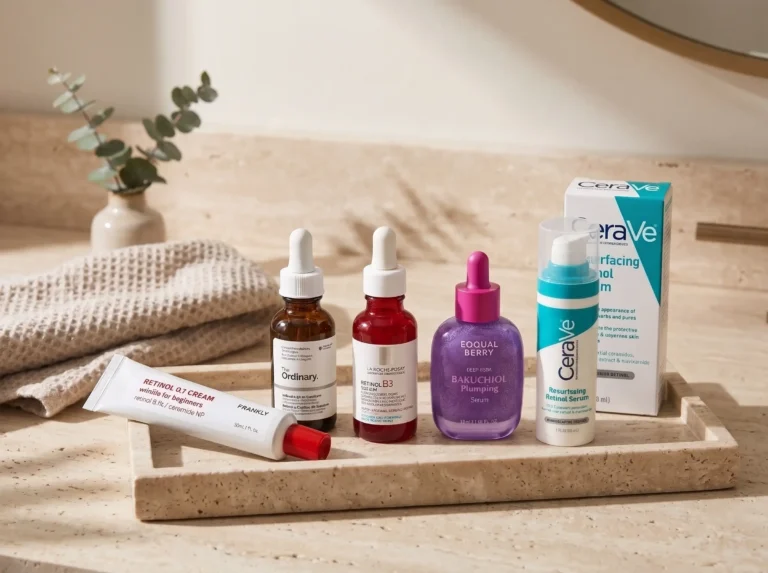
- Retinol: CeraVe Skin Renewing Retinol Serum is a widely available, fragrance-free, gentle starting option.
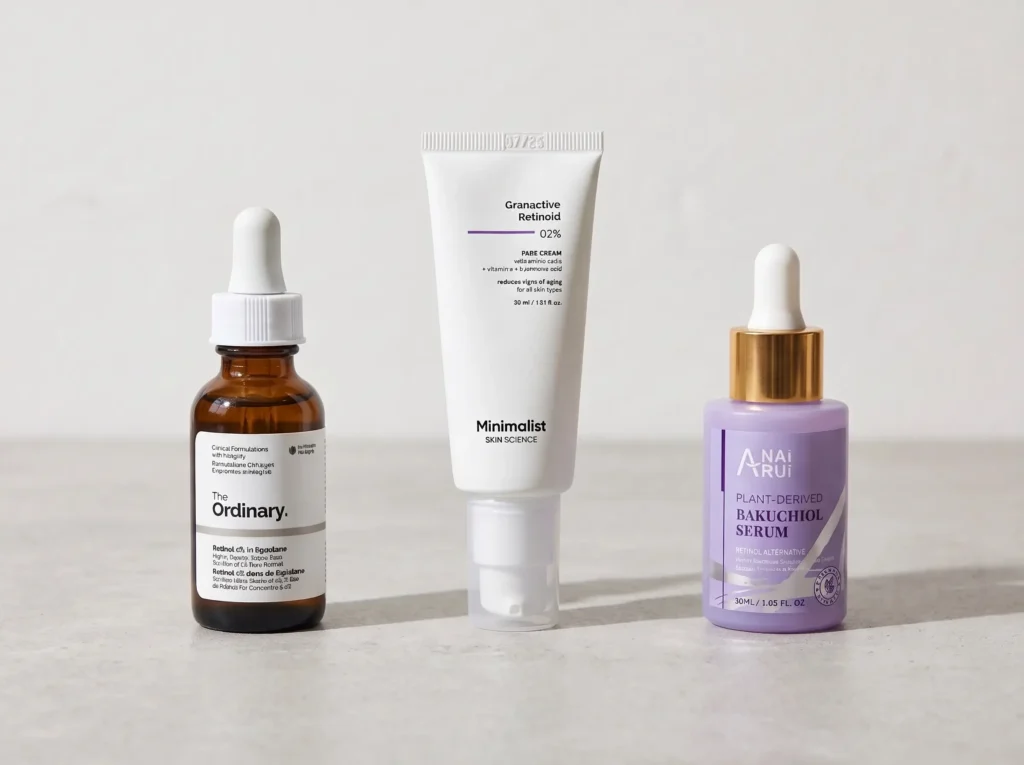
- Bakuchiol: Herbivore Bakuchiol Retinol Alternative Smoothing Serum is one commonly mentioned option. Check availability and the exact product name before you buy.
Common Mistakes
- Starting too strong or too often.
- Skipping sunscreen.
- Layering several actives at once.
- Expecting overnight results.
- Assuming “natural” means gentle. Plant-derived ingredients can still irritate.
- Using retinoids during pregnancy without medical advice.
Your Quick Checklist
- [ ] I know whether I’m pregnant, trying, or breastfeeding, and I’ve asked a doctor if needed.
- [ ] I’ve chosen one product, not three.
- [ ] I patch tested it.
- [ ] I’m starting with 1 to 2 nights per week.
- [ ] I use sunscreen every morning.
- [ ] I’m keeping the rest of my routine gentle.
- [ ] I’ll give it at least 8 to 12 weeks.
Frequently Asked Questions
Is retinol a retinoid?
Yes. Retinol is one type of retinoid, and a milder one than prescription forms.
Is bakuchiol as good as retinol?
A small study found similar results with less irritation, but research is limited, so it isn’t proven to be equivalent.
Can I use bakuchiol and retinol together?
Some people do, but there’s little research. If you try it, introduce them one at a time.
How long does it take to see results?
Usually at least 8 to 12 weeks of consistent use, and longer for deeper changes.
Can I use retinol in the morning?
It’s usually used at night, since it can make skin more sun-sensitive, and some forms are less stable in light.
Final Thoughts
Retinoids are a family, retinol is one gentler member of it, and bakuchiol is a different ingredient altogether that may suit people who can’t tolerate retinoids. Start slowly, protect your skin from the sun, and be patient. If you’re unsure, a dermatologist can help you choose the right option for your skin and your situation.